The Future War Conference — We have the technology. A trade show set in the future.
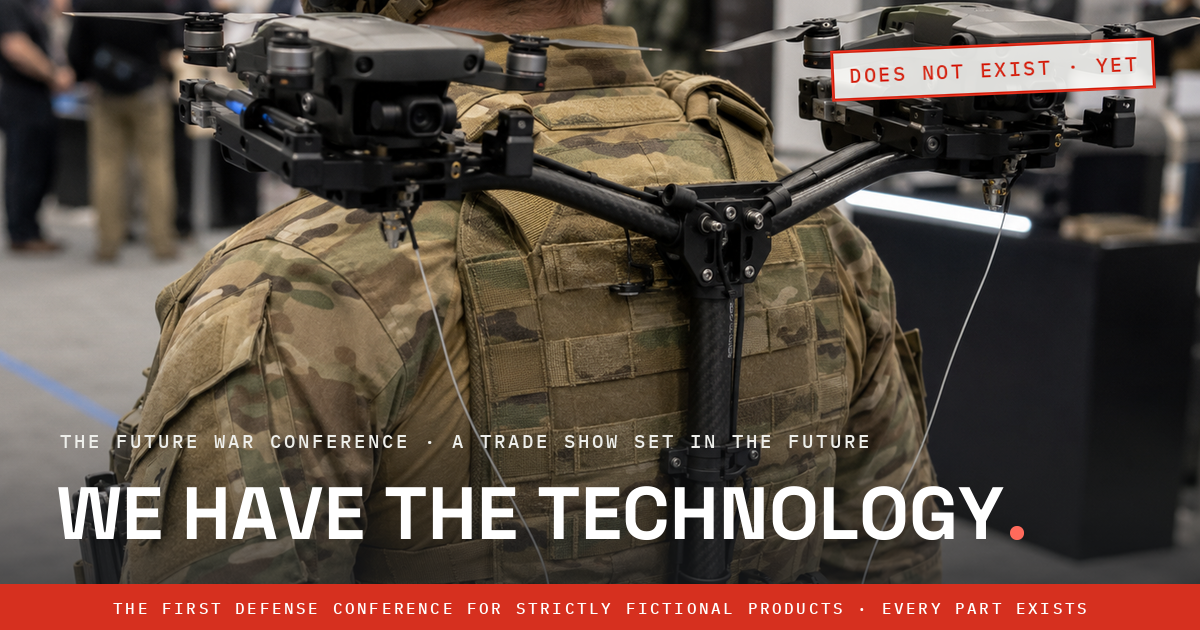
The first defense conference for strictly fictional products. Every exhibit on the floor is a product that does not exist — built entirely from ingredients that do. Every exhibitor — prime, startup, lab, or lone grad student — presents from a declared year in the future, with a bill of materials that resolves to real parts, real papers, real TRLs, and a year that lives in a public ledger until it is graded. Useful fiction, with receipts. FICINT you can walk through.
Initial cohort: the useful-fiction community, war college futures programs, autonomy & defense primes' concept teams, underwriters, the writers who got here first — and anyone with a serious sheet. No affiliation required.
§1 — Declared fiction
Every arms show already exhibits fiction. This is the first one that declares it.
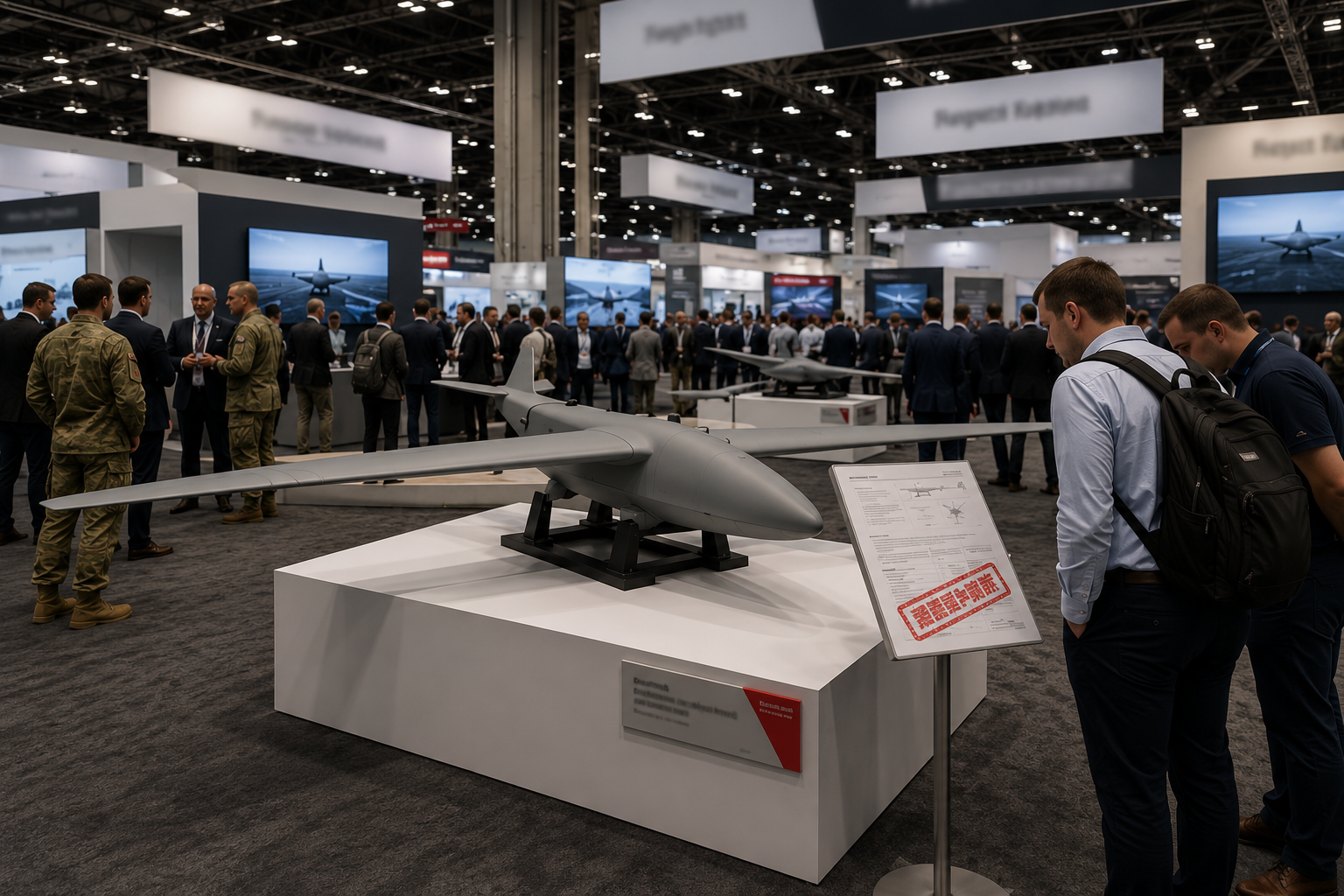
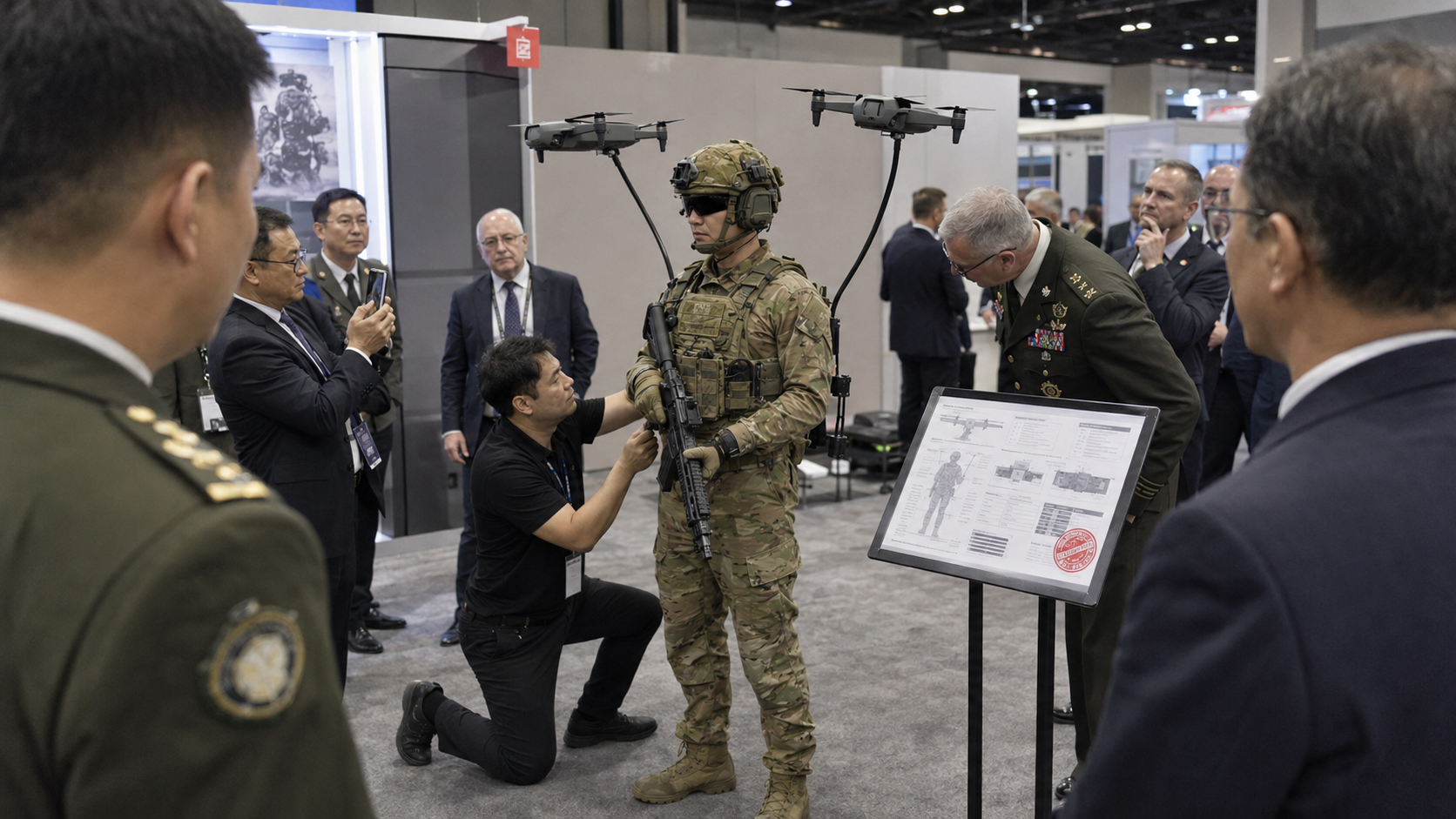
Walk any major defense expo and a share of the floor is renders, full-scale mockups, and brochures for systems with no funded program behind them — undeclared fiction parked beside flying hardware, borrowing credibility from the booth next door and repaying it in doubt. The buyer can't tell concept from product, so everything gets discounted, and the honest exhibitors subsidize the vapor.
Here, fiction is the admission criterion. Nobody can fake existence at a show where existence is disqualifying. And the stigma inverts: at the mixed shows, exhibiting a concept signals you lack product; on a floor that is fictional by rule, speculation is a safe harbor — which is exactly the condition under which people show you their ambitious ideas instead of their fundable ones.
Defense has ready-to-wear shows on every continent, and no couture week. This is the couture week — with a bill of materials.

§2 — The premise
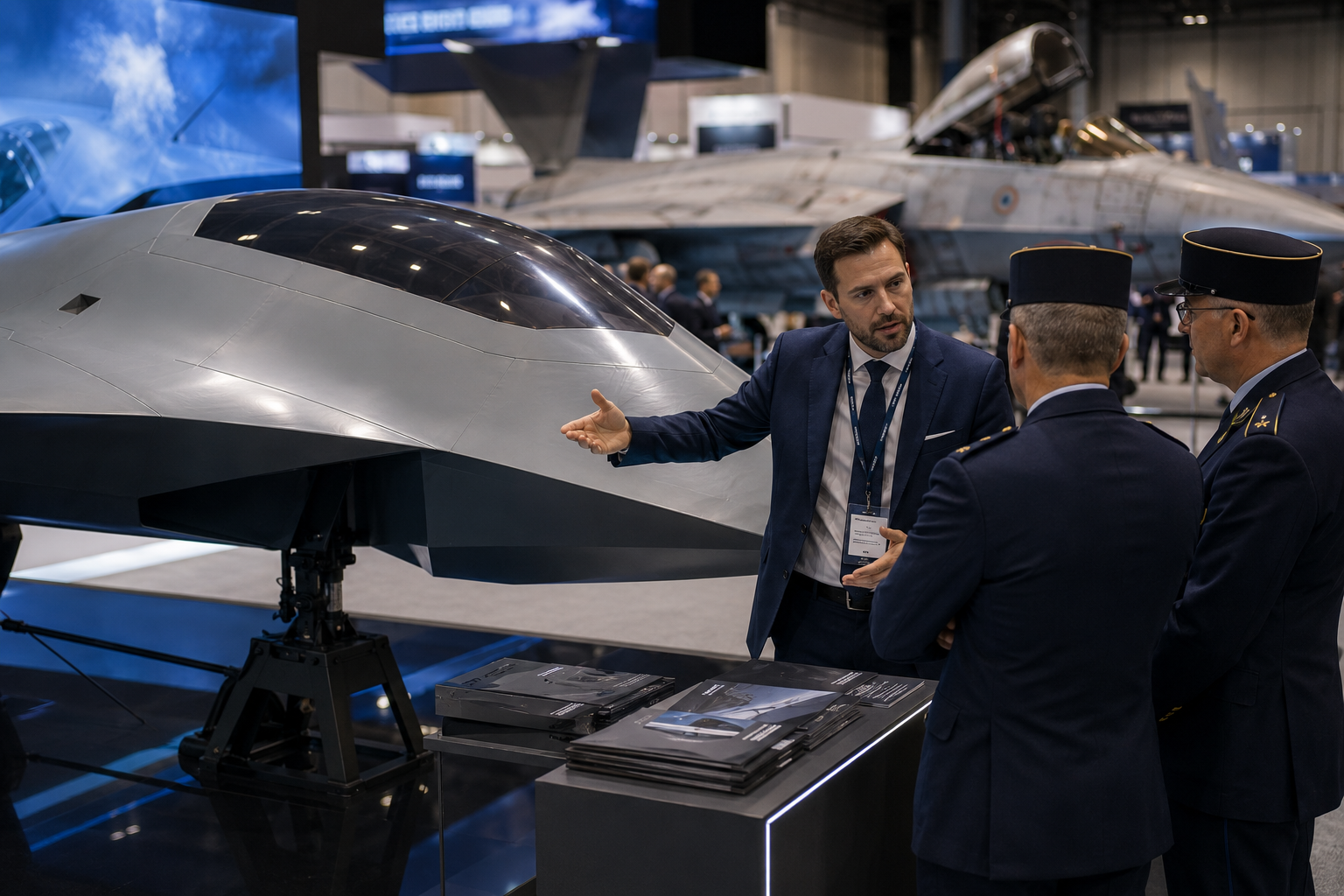
Creativity is the hard part. The parts list is technically the easy part.
Defense industrialized imagination decades ago. Independent R&D is reimbursed as allowable overhead by regulation; the services award contracts where the conceptual design is the entire deliverable; the primes staff standing concept shops whose most valuable product has always been the idea. The creative work is real, funded, and professional.
It is also captive. One buyer shapes every concept toward what source selection will score — four conceptual-design contracts return four loyal wingmen, not four futures. The best work disappears into classified programs: unpublished, unpriced, ungraded, uncontested by anyone without a clearance. The industrial base has concept factories. It has no concept exchange — no venue with open provenance, public grading, and selection pressure from an audience rather than a customer.
They industrialized the creative part. Nobody built the exchange.
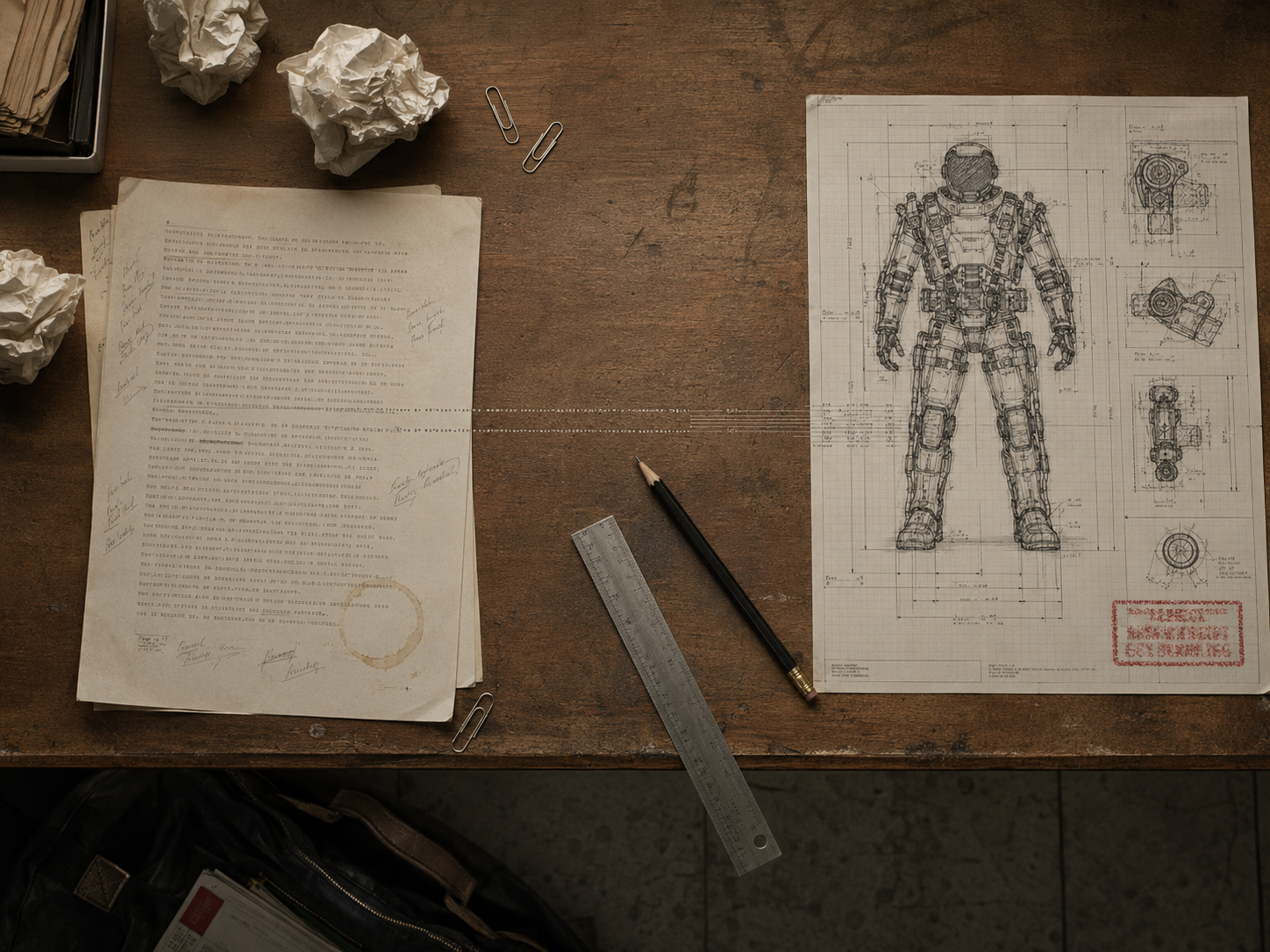
§3 — The Rule of Ingredients
Three clauses separate this from vaporware, science fiction, and every concept-car keynote ever given.
§3.1 — NONEXISTENCE
The product must not exist.
No prototypes, no MVPs, no "early access." If it ships, it exhibits somewhere else. The floor is reserved for the adjacent possible — the things one integration effort away.
§3.2 — PROVENANCE
Every subsystem must exist.
Each exhibit files a provenance sheet: the design decomposed to subsystems, each at TRL 6 or better, each traceable to a citable paper, a fielded system, or an orderable part number. The footnote is the genre's credibility engine. The bill of materials is the footnote, in atoms.
§3.3 — THE YEAR
The year is a forecast, and forecasts get graded.
"Set in 2031" is not set dressing — it is a staked claim that the product could exist by 2031. Every edition opens with the Retrospective Hall, where prior years' claims are scored in public.
§4 — How to exhibit
No badge required. A prime's concept shop and a grad student file the same sheet.
The primes already have captive concept teams; the marginal value of this floor is everyone who doesn't — the researcher, the student, the retired chief with the one idea he's carried for twenty years. The precedent is DEF CON: hobbyists presenting beside the NSA, and the floor becoming the industry's recruiting event by accident. Four steps stand between anyone and a booth.
STEP 1 — EDITORIAL REVIEW
Does the fiction hold?
The bar is not polish, and it is not affiliation. It is seriousness of the fiction: a coherent answer to what world this exists in, and why that world buys it. Curation is the difference between couture week and a poster session.
STEP 2 — THE PROVENANCE SHEET
The equalizer.
One page, public, auditable — and the same rubric for everyone. A sophomore's sheet and a prime's sheet get graded identically, and the sophomore can win. §3 applies in full; the sheet is where affiliation stops mattering.
STEP 3 — THE COMMITMENT CLAUSE
If someone serious wants it, you deliver — at your declared tier.
Every exhibit is a firm offer, not an art piece: an option someone in the room can exercise. The tier states what exercising it delivers. This clause is what separates a floor from a gallery.
BUILD — you have the shop; a serious buyer gets the product.
LICENSE — you have the design; a serious buyer gets the rights.
JOIN — you have the idea; funded, you go build it with them.
STEP 4 — PROFIT
Several currencies.
Letters of intent and licenses are the obvious ones. The sleeper is the JOIN tier: it makes the floor a talent market, where a booth is a résumé with a bill of materials. And the compounding one is calibration — claim 2031, be right, and the badge becomes career capital nobody can issue themselves.
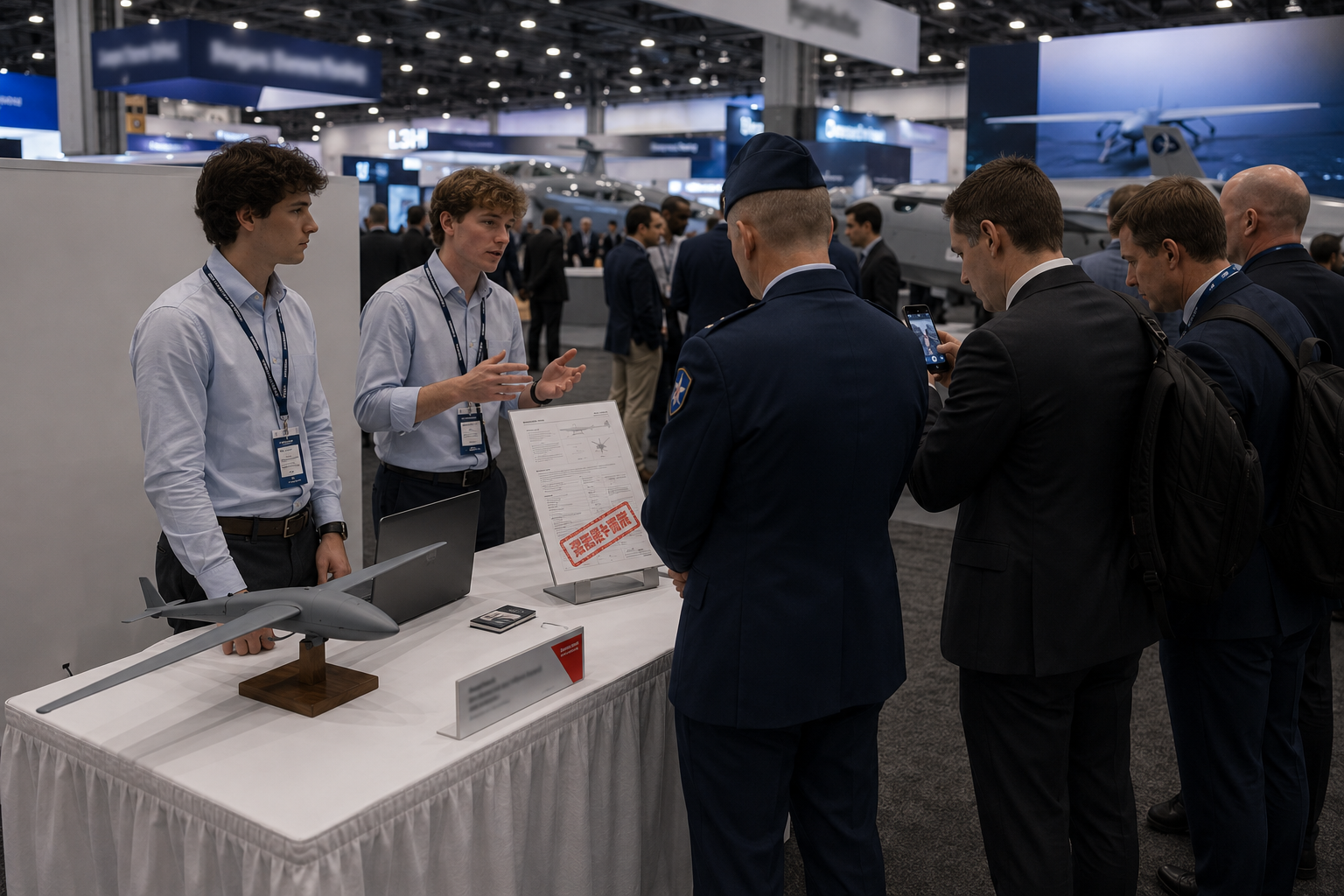
§5 — Sample exhibit
What a booth files before it builds anything.
A worked example. The product below does not exist. Every row of it does. Tap a subsystem for its basis. A sheet like this could be filed by a prime's concept shop or a four-person team; the floor doesn't ask which.
LONGWATCH — autonomous search-and-rescue picket, self-refueling, 90-day station
SET IN 2031
COMMITMENT: BUILD
| Subsystem | Readiness | Status |
|---|---|---|
| Long-endurance maritime airframe (solar-hybrid) | TRL 8 | EXISTS |
BASIS: fielded HAPS/MALE platforms, multiple vendors; 60+ day continuous-flight demonstrations on record. Marinization is engineering, not research. | ||
| Autonomous aerial refueling / energy transfer | TRL 7 | EXISTS |
BASIS: autonomous probe-and-drogue and boom contact demonstrated operationally (carrier-based tanking program, 2020s); drone-to-drone transfer demonstrated at small scale. | ||
| Maritime distress detection (EO/IR + RF fusion) | TRL 9 | EXISTS |
BASIS: 406 MHz EPIRB/PLB constellation processing is decades old; shipboard-class EO/IR person-in-water detection models published and fielded in coast guard trials. | ||
| On-station autonomy under comms denial (SHADOW-default behavior stack) | TRL 6 | EXISTS |
BASIS: local-autonomy fallback with conservative defaults demonstrated in multiple swarm programs; the hard part is doctrine, not code — which is why it's on this floor. | ||
| LONGWATCH — the integrated product | TRL — | DOES NOT EXIST |
CLAIM: integrable by 2031. This row is the exhibit. This row is what gets graded. | ||
↑ every row: tap for basis. The last row is always the product, and the last row is always red.
§6 — The Ledger
The year on the badge is a Brier score waiting to happen.
Every claim filed on the floor enters the Ledger — a standing public registry, with resolution criteria written at filing, not at grading. Between editions the claims stay live: underwriters requote premiums, forecasters post odds, letters of intent accrue against the row. Each edition opens in the Retrospective Hall, where every expired claim is settled in public — exists, slipped, or vindicated — and exhibitors carry the calibration record on the badge. The conference is the settlement day; the Ledger runs all year. The costume party becomes a market the moment the forecast has a price.
| Class of 2028 (illustrative) | Claimed | Verdict |
|---|---|---|
| Cross-party in-flight abort protocol | 2028 | EXISTS |
| Attrition-linked insurance notes, drone fleets | 2028 | EXISTS |
| Uncrewed tanker-to-tanker logistics loop | 2028 | SLIPPED → 2030 |
| Single-operator 200-drone control station | 2028 | EXISTS |
| Treaty annex distributed as signed config | 2028 | DOES NOT EXIST |
Sandbagging costs points. Scoring rewards the nearest defensible year, not the safest distant one — a claim set in 2040 earns almost nothing for coming true.
Resolution is pre-registered. A Resolution Council — forecasting professionals plus domain referees — grades each claim against the criteria filed with it, not against the vibe in the room. No claim ages without a written test for what "exists" means.
Demand clears early. Attendees file letters of intent conditional on existence — each one a row in the Ledger against the exhibit it prices. The floor doubles as a bookbuild for the adjacent possible: the missing market where buyers signal before anyone spends the NRE.
The honest oracle has a booth. An underwriter quotes premiums on exhibits, in-world. A priced policy on a fictional product is the most credible review in the building.
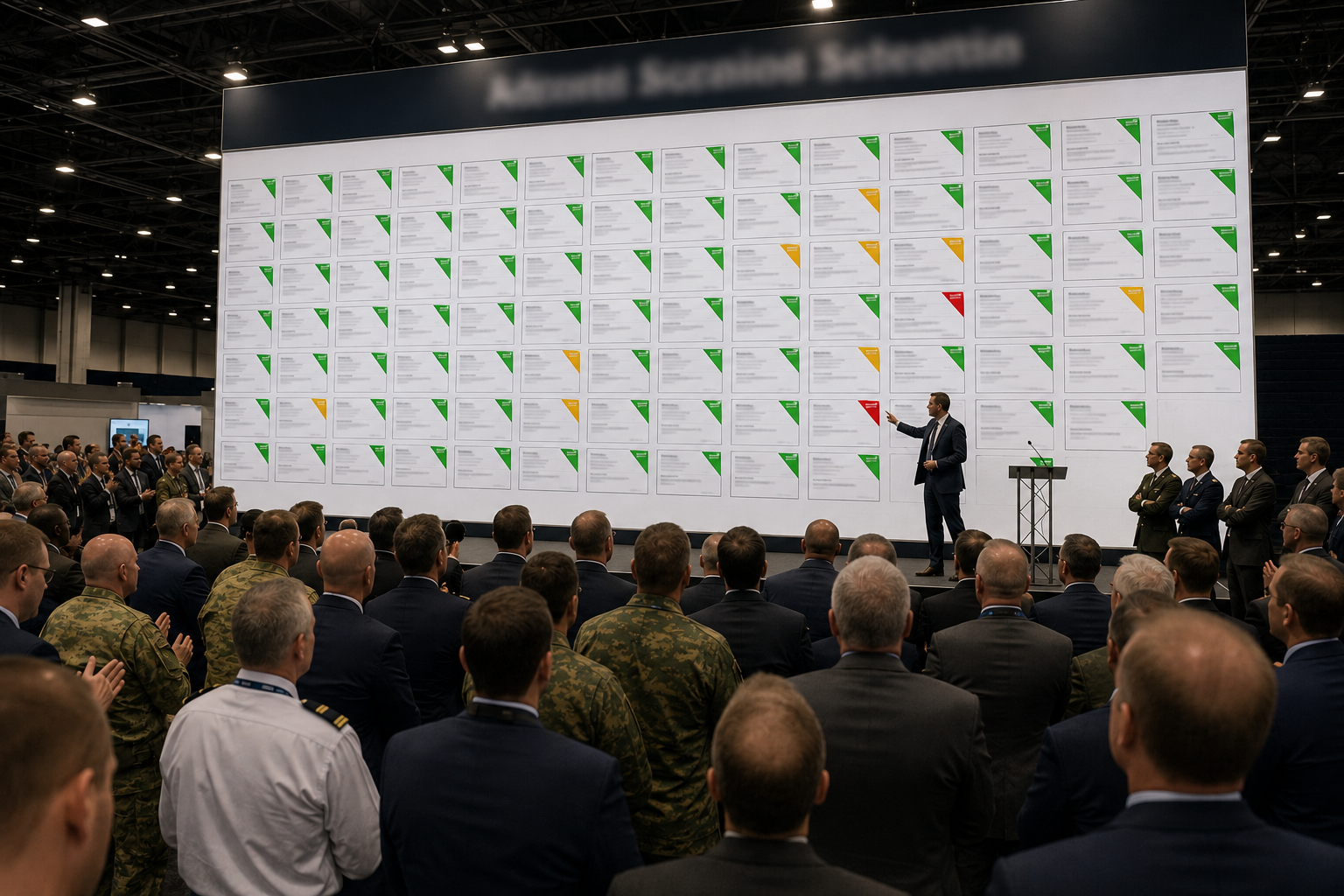
§7 — The floors
Three floors. One rulebook.
Floor A — Open
The Commercial Floor
Dual-use and civil exhibits: logistics, SAR, sensing, resilience. Public provenance sheets, press welcome, students free — and student booths beside prime booths, graded by the same rubric. Where the genre recruits its next generation.
Floor B — Cleared
The Annex
The buildable-but-unbuilt that should not be published with a recipe attached. Access-controlled, allied-audience sessions run with partner institutions. The provenance discipline is identical; the audience is not.
Floor C — Warnings
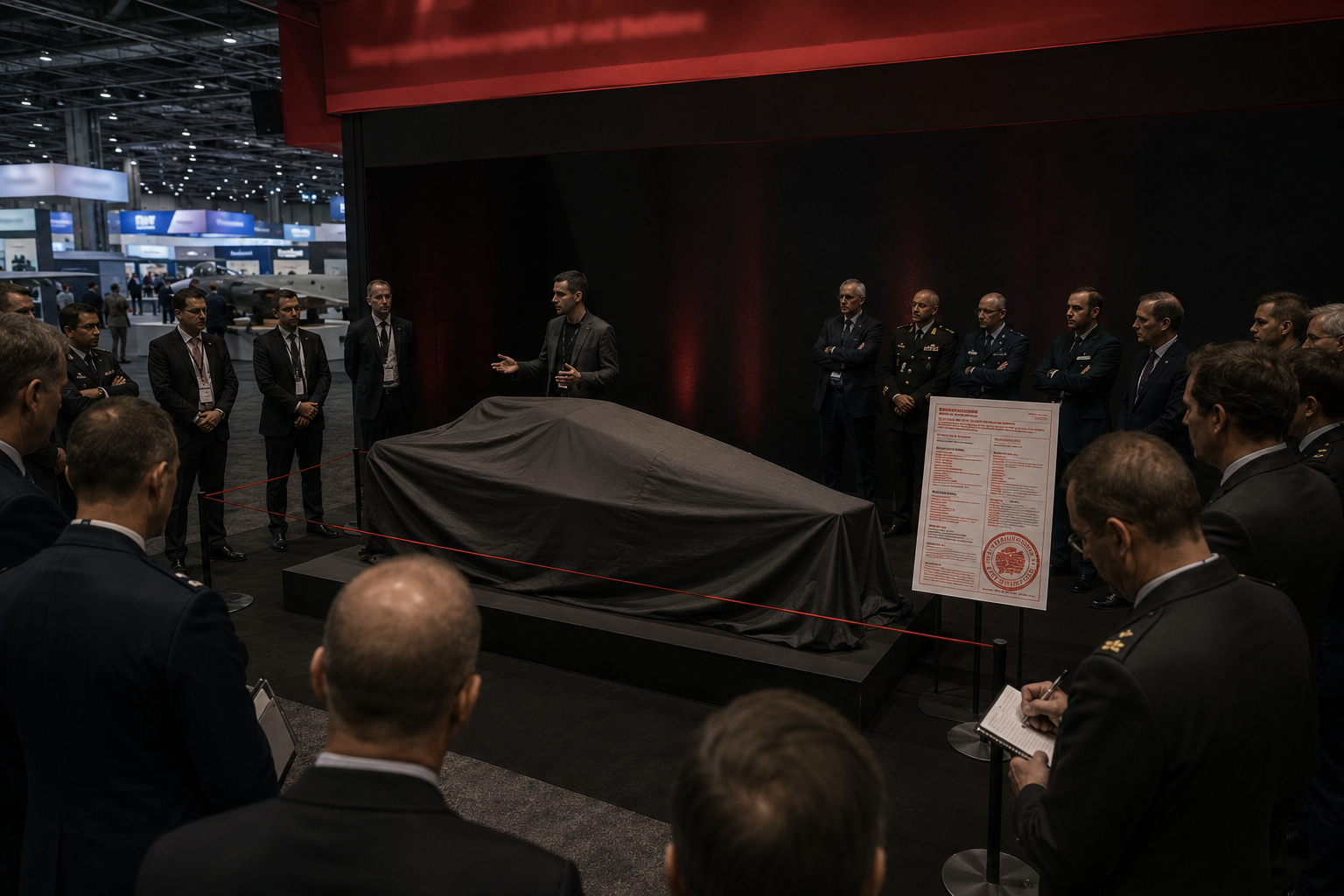
The Red Pavilion
Exhibits argued against: products whose ingredients exist and whose exhibitors make the case that they should stay unassembled. Useful fiction's original job — exposing futures in order to prevent them — given a booth, a bill of materials, and a straight face. Red sheets cite capability classes, never integration recipes; anything recipe-shaped belongs in the Annex. We have the technology. That is the warning.
§8 — Edition Zero
The proceedings ship before the conference does.
The first artifact is not a floor. It is a catalog: Catalog №0, a mail-order catalog of products that do not exist — every listing backed by a one-page provenance sheet, every year a claim opened in the Ledger, every order form a letter of intent conditional on existence. Twenty-four exhibits, print and web, launched at a one-day invitational — listings solicited from primes' concept teams and unaffiliated builders alike, under the same four steps as the floor.
Catalog №0 · First printing
Goods from the adjacent possible
Deliveries 2028 – 2040 · prices on request
Nothing in this catalog exists. Every part in it does. Each listing decomposes to orderable subsystems, cited to TRL, dated as a public claim.
☐ Order form enclosed — letter of intent, conditional on existence, entered to the Ledger
Paper beats venues. A catalog ships for the cost of a print run, not a convention center. Edition Zero proves the format — provenance sheets, graded years, conditional demand — before anyone rents a hall or sells a booth.
It is a book-shaped object. The genre's authors work in print. A catalog is a FICINT anthology wearing a Sears jacket: every listing is a story with part numbers, and the whole volume is the demand instrument. The 1893 Sears catalog built an empire publishing want before inventory; this one publishes want before existence.
Every page is a press hook. A product that does not exist — priced, sourced, and dated in public — is a headline per listing. The catalog recruits the first floor's exhibitors by showing them their booth in print.
§9 — Founding cohort
Built with the people who invented the genre, not around them.
- The useful-fiction / FICINT communityThe rulebook is yours — rules of the real, applied to hardware. The conference is the genre's trade-show form factor, and it doesn't happen without its authors in the room.
- War college & futures programsRetrospective Hall as a standing calibration exercise; student exhibits as coursework with a public grade.
- Primes' concept teams & autonomy startupsA venue where the concept deck is the product, the demand signal arrives before the NRE, and the forecast builds reputation instead of burning it.
- Students, independents, unaffiliated buildersThe floor's whole point: the concepts the org charts can't produce. Editorial review is the only gate, the sheet is the equalizer, and the JOIN tier means an idea is enough inventory to exhibit.
- Underwriters & forecastersThe scoring layer needs professionals: proper scoring rules, priced premiums, resolution criteria written before the claims age.
- Writers, worldbuilders, production designersDiegetic prototypes are a craft. The booths are stories with part numbers, and somebody has to make them land.
- Publishers & pressCatalog №0 is a book-shaped object with a news hook per listing: a product that doesn't exist, priced, sourced, and dated in public.
§10 — This document practices what it files
Provenance sheet: The Future War Conference.
| Ingredient | Origin | Status |
|---|---|---|
| Useful fiction / FICINT — rules of the real | Singer & Cole, 2015 — a novel where every imagined system carries an endnote to a real one; adopted across US, UK, AUS, FR defense communities | EXISTS |
| Diegetic prototypes | Kirby, 2010 — artifacts that persuade by existing inside a story | EXISTS |
| Technology Readiness Levels | NASA, 1970s; now the lingua franca of every acquisition office | EXISTS |
| Industrialized concept work | IRAD reimbursement by regulation; conceptual designs awarded as contract deliverables | EXISTS |
| Open floor — amateurs beside agencies | DEF CON, 1993 — hobbyists presenting beside the NSA | EXISTS |
| Proper scoring rules & calibration | Brier, 1950; forecasting-tournament practice, 2010s– | EXISTS |
| Conditional demand aggregation (LOI bookbuild) | Standard capital-markets mechanics, repointed at products that don't exist yet | EXISTS |
| Mail-order catalog as demand instrument | Sears, Roebuck & Co., 1893 — publishing want before inventory | EXISTS |
| The Future War Conference | — | DOES NOT EXIST |
§11 — The last row is red on purpose
Help us grade this claim.
We have the technology. What doesn't exist is the room. Seeking founding partners across the useful-fiction community, futures programs, the autonomy industry, publishing, and the forecasting world — co-designers of the rulebook, the Ledger, and Catalog №0 — and the catalog's first exhibitors, affiliation optional. The conference is currently a provenance sheet. That's the point.
Get in touch — founding cohortdehnbostele@gmail.com · manifesto (PDF) · concept spec & rulebook draft available on request